
- Lecture 1: Environment Setup, Data Types, Conditionals, Loops
- Lecture 2: Functions, Recursion, Time Complexity
- Lab: Shapes Printer, Console Animation
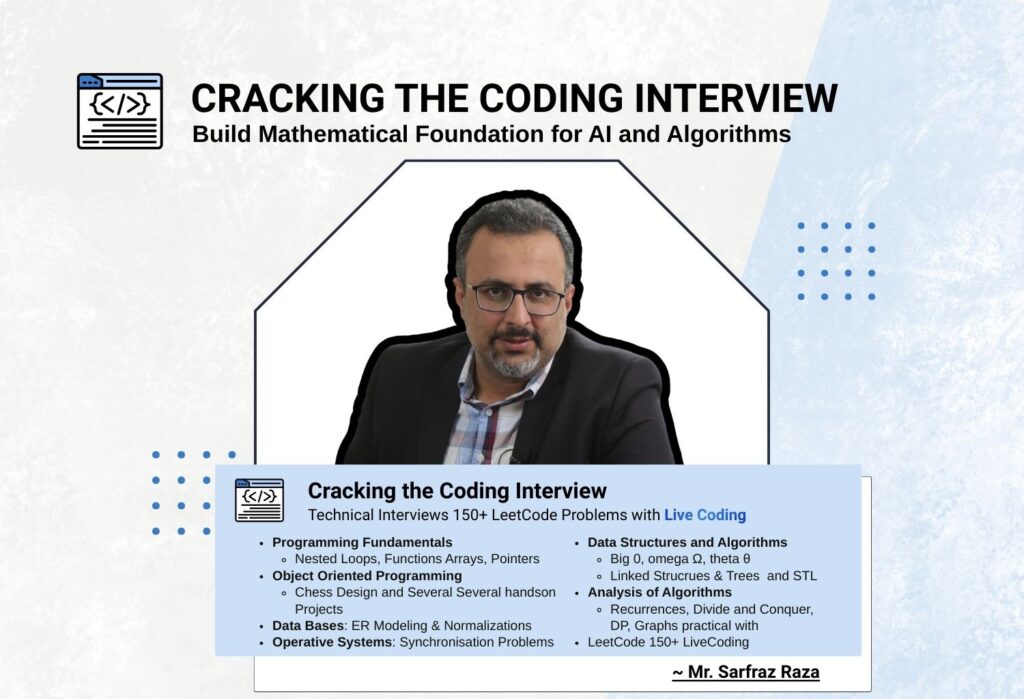
Cracking The Coding Interview
Fee: 12,000 /- PKR (per-month)
Registration Fee: 1,000 /- PKR
(non-refundable)
- Duration: 6 Months
- Starting: To Be Announced
- Mode: Physical
- Days: To Be Announced
- Day-1: To Be Announced
- Day-2: To Be Announced
- Location: To Be Announced
In Collaboration with Information Technology University (ITU)
Who can join this course?
This course is suitable for students and professionals who want to strengthen their problem-solving skills and prepare for technical coding interviews. It is ideal for computer science students, software engineering students, and IT graduates, as well as self-taught programmers who have basic programming knowledge. Anyone preparing for internship interviews, job placements, or competitive coding assessments can benefit from this course. A foundational understanding of at least one programming language (such as C++, Java, or Python) is recommended.
About Course
Cracking the Coding Interview is a comprehensive, interview-focused course designed to prepare learners for technical coding interviews through structured problem-solving and in-depth concept building. Over seven weeks, the program guides students through core computer science fundamentals including data understanding, algorithm efficiency, and effective problem-solving strategies. The course covers essential topics such as arrays, strings, stacks, queues, STL, recursion, dynamic programming, graphs, greedy algorithms, priority queues, and dynamic data structures like linked lists, hash tables, and binary trees. Learners practice with 150+ LeetCode problems, gaining hands-on experience in solution space exploration and optimization. In addition, the course strengthens interview readiness through object-oriented programming, databases, operating systems (threads and locks), theory of computation, and quantitative and analytical problem solving equipping participants with both the technical depth and confidence required to succeed in real-world technical interviews.
Course Outline
Month 1: Programming Fundamentals
Week 1: Loops, Functions & Basics
Week 2: Arrays & Sorting
- Lecture 1: Arrays, Strings, 2D Arrays, Searching
- Lecture 2: Sorting Algorithms, Merge & Quick Sort
- Lab: Voting System, Snakes & Ladders
Week 3: Pointers & Memory
- Lecture 1: Pointers, Stack vs Heap, Dynamic Memory
- Lecture 2: Function Pointers, Const & Smart Pointers
- Lab: Gomoku Game
Week 4: Structs & Chess Project
- Lecture 1: Structs, Enums, Data Modeling
- Lecture 2: File Handling, Function Pointer Dispatch
- Lab: Chess Game (Procedural)
Month 2: OOP & Design Patterns
Week 5: Classes & OOP Basics
- Class Structure, Constructors, Destructors
- Lab: Polynomial Calculator
Week 6: Operator Overloading
- Arithmetic & Advanced Overloading
- Lab: Huge Integer Project
Week 7: Relationships & STL
- Object Relationships, Design Patterns
- Lab: LUDO Game
Week 8: Inheritance & Polymorphism
- OOP Concepts, Behavioural Patterns
- Lab: Chess (OOP Version)
Month 3: Data Structures & STL
Week 9: Stack, Queue, Vector
Implementation and STL mapping of basic data structures.
Week 10: Linked Lists
Singly, Doubly, and Circular linked lists with applications.
Week 11: Trees
Binary Trees, BST, AVL, Heaps, and Tries.
Week 12: Hashing
Hash tables, collision handling, and real-world use cases.
Month 4: Algorithms
Week 13: Divide & Conquer
Recurrence relations and divide & conquer strategies.
Week 14: Dynamic Programming
Optimization using DP (1D, 2D, advanced patterns).
Week 15: Greedy Algorithms
Greedy strategies and optimization problems.
Week 16: Graph Algorithms
BFS, DFS, shortest paths, and graph problems.
Month 5: Operating System, Database & Designs
Week 17: Operating Systems
Processes, scheduling, threads, synchronization.
Week 18: Memory & File Systems
Memory management and file handling systems.
Week 19: Databases (SQL)
SQL, indexing, transactions, and database design.
Week 20: System Design
Scalable systems, architecture, and design patterns.
Month 6: Mock Interviews
Week 21: DSA Mock Interviews
Practice real interview-style coding problems.
Week 22: System Design Interviews
Mock interviews focused on system design.
Week 23: Behavioural Preparation
Communication, HR questions, and STAR method.
Week 24: Final Mock & Launch
Full interview simulation and final preparation.
Recorded Lectures
With lifetime access to our lecture content,
you can revisit and refresh your concepts at your convenience.
Nourishing the Programmer in you!
schoolofseedprogramming@gmail.com
query@seedprogramming.org
Hello 👋
Can we help you?
Need more information about Cracking the Coding Interview
Can we help you?
Need more information about Cracking the Coding Interview
Open chat