Seed Programming

Programming With C++

Fee: 12,000 /- PKR per month

Registration Fee: 1,000 /- PKR
(non-refundable)

In Collaboration with Information Technology University (ITU)

Who can join this course?

If you're at the beginning of a BS degree in Computer Science, Software Engineering, Data Science, Machine Learning, or Artificial Intelligence at any university or affiliated college in Lahore or its vicinity, this is an excellent opportunity to build a strong foundation for your journey in this field.

About Course

Dive into the world of computational problem-solving with this hands-on programming course for C++ and Python users, built on the philosophy of learning by doing. Master control structures, functions, structured data, arrays/lists, references & pointers (or object references), and static vs dynamic memory models while exploring stack and heap through visual memory diagrams.
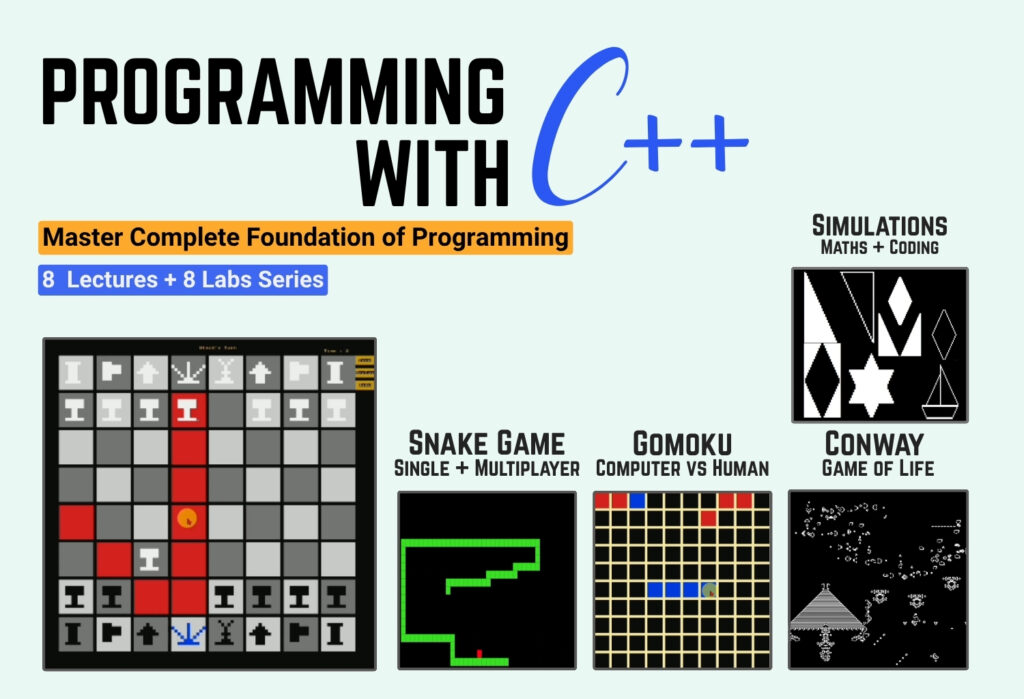
Engage in extensive problem-solving practices and analytical exercises that strengthen logical thinking, algorithmic design, and code reusability. Experience the excitement of building many real-world projects from Conway’s Game of Life to GOMOKU, and the final masterpiece, The Game of Chess. A journey designed to turn programming principles into precision, creativity, and mastery, regardless of whether you code in C++ or Python.

Course Outline

Lecture 1: Computational Thinking & C++ Foundations

Students build a strong foundation in computational thinking and C++ programming. They learn how programs work, write their first C++ programs, work with variables and expressions, and use while loops to solve basic computational problems.


  • Why programming, why C++, cout, expressions and variables
  • Computational thinking, algorithms and problem-solving strategies
  • While loops, loop counters and generalized table generation
  • Practical problems: Measuring Water, Handshake Counting and Heaviest Ball
Lecture 2: Control Structures, Functions & Program Design

Students learn how to control program flow using conditions, operators and switch statements. The session introduces functions as reusable building blocks and applies them to practical decision-making and menu-driven programs.


  • Integer data types, arithmetic operators, modulus and divisibility
  • if, if-else, if-else-if and compound conditions
  • Characters, ASCII and character classification
  • Functions, parameters, return values and reusable utilities
  • Switch statements, menu-driven applications and calculators
Lecture 3: Loops, Nested Loops & Problem-Solving Patterns

Students develop stronger problem-solving skills by combining loops, nested loops and reusable functions. They solve numerical problems, analyze input streams, generate patterns and implement classic algorithms.


  • for vs while loops, series and sequence generation
  • Nested loops, prime numbers, composite numbers and triangle numbers
  • Fibonacci, sentinel-controlled input and stream statistics
  • Reverse numbers, palindrome checking and perfect squares
  • Pythagorean triples and pattern/shape generation
Lecture 4: References, Pointers & Static Arrays

Students explore how C++ works with memory through references, pointers and arrays. They learn practical array-processing techniques including searching, frequency analysis, sorting and merging.


  • Memory concepts, references and reference parameters
  • Pointers, addresses, dereferencing and pointer-based parameter passing
  • Static arrays, memory layout, capacity and size
  • Searching, frequency tables, distinct/unique elements and mode
  • Bubble sort, selection sort, merging and array segregation
Lecture 5: 2D Arrays, Structs & Console Animation

Students move from one-dimensional data structures to two-dimensional arrays and structured data. They work with matrices, create custom structures and build interactive console-based visual programs and animations.


  • Two-dimensional arrays, memory mapping and matrix operations
  • Matrix addition, subtraction, multiplication and transpose
  • Structs, Position and Matrix structures, and arrays of structures
  • Console dimensions, positioning, screen clearing and timing
  • Fan animation, circle drawing and multiple moving objects
Lecture 6: Dynamic Memory & Dynamic Data Structures

Students understand why static arrays can be limiting and learn how dynamic memory allows programs to work with data whose size is determined at runtime. The session introduces heap and stack concepts, dynamic arrays, sets and dynamically allocated matrices.


  • Static vs dynamic memory, code/global, stack and heap segments
  • Dynamic memory allocation and runtime arrays
  • Growable arrays, InsertAtEnd, dynamic searching and sorting
  • SET structure, set union and file-based data loading
  • Dynamic 2D arrays and dynamically allocated matrices
Lecture 7: Game Architecture & Interactive Programming

Students apply their programming knowledge to interactive programs and games. They learn how to manage program state, process input, update game logic and display results through projects such as Game of Life, Gomoku and Snake.


  • State-based programs and the Input → Update → Display flow
  • Conway's Game of Life, world initialization and repopulation
  • Gomoku: board design, turns, valid moves, wins and draws
  • Interactive keyboard input using _getch and _kbhit
  • Snake representation, movement, collision and game-state updates
Lecture 8: Large-Scale Program Design — Chess

The final session brings together the major concepts from the course through a large-scale Chess project. Students work with board representation, movement rules, state management and advanced game logic while developing a complete interactive application.


  • Program requirements, state representation and main-flow design
  • 8×8 board, pieces, coordinates and movement abstraction
  • Rook, Bishop, Queen, King, Knight and Pawn movement rules
  • Path checking, legal moves, turns, captures and promotion
  • Check, checkmate, stalemate, castling and illegal moves
  • Save, undo, replay and restart functionality

Recorded Lectures

With lifetime access to our lecture content,
you can revisit and refresh your concepts at your convenience.