
Propositions & truth tables (AND, OR, XOR, …), logical implication & equivalence, quantifiers (∀, ∃), direct proof vs contradiction, arithmetic & geometric series proofs, prime numbers, AI applications (rule-based systems, dataset splits, feature sets)
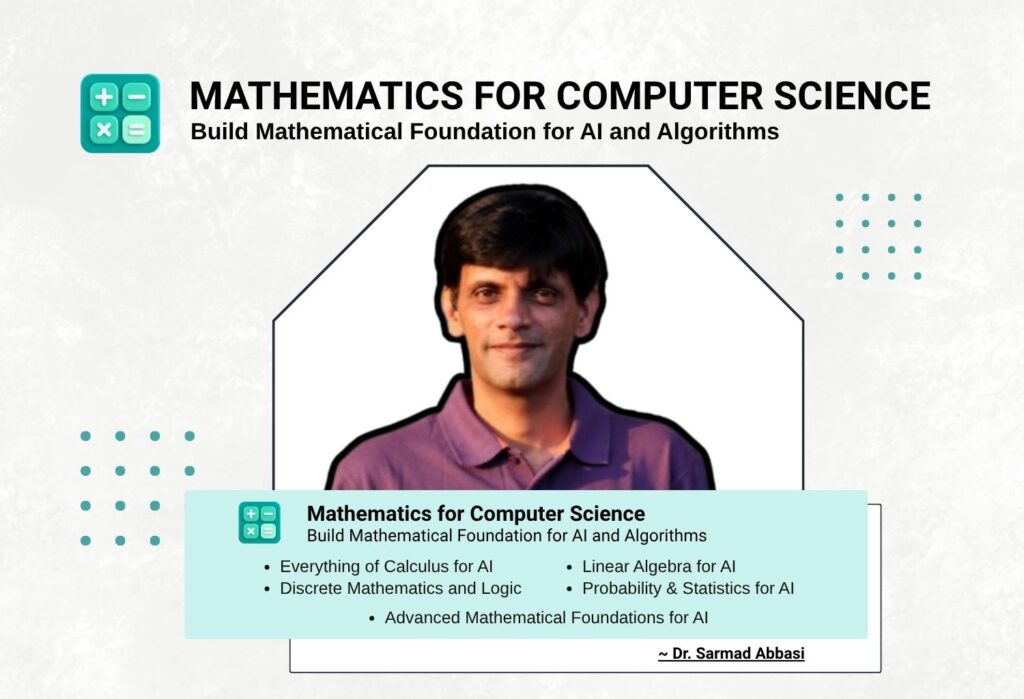
Mathematics For Computer Science
Fee: 12,000 /- PKR (per-month)
Registration Fee: 1,000 /- PKR
(non-refundable)
- Duration: 6 Months
- Starting: To Be Announced
- Mode: Physical
- Days: To Be Announced
- Location: To Be Announced
In Collaboration with Information Technology University (ITU)
Who can join this course?
If you're at the beginning of a BS degree in Computer Science, Software Engineering, Data Science, Machine Learning, or Artificial Intelligence at any university or affiliated college in Lahore or its vicinity, this is an excellent opportunity to build a strong foundation for your journey in this field.
About Course
Mathematical Foundations for AI and Algorithmic Thinking is a comprehensive course designed to build the core mathematical intuition required for Artificial Intelligence, Machine Learning, and advanced algorithms.
Engage in mastering the core pillars of AI: Discrete Mathematics, Calculus, Probability, and Linear Algebra transformed from abstract formulas into practical tools for building intelligent technology.Explore the ideas behind intelligent systems through hands-on mathematical modeling connecting theory to neural networks, optimization, probabilistic learning, and high-dimensional data. This journey is designed to turn mathematical principles into clarity, confidence, and creative problem-solving, whether your path leads to Machine Learning, Data Science, competitive programming, or AI research.
Course Outline
Conceptual Foundations of Mathematics for AI
Month 1
Module 1: Discrete Mathematics for AI
Lecture 1: Logic, Proofs & Sets
Lecture 2: Mathematical Induction & Time Complexity
Mathematical induction proofs, recursion, Big O / Theta notation, set theory basics (closure, transitivity, symmetry)
Lecture 3: Counting & Combinatorics
Counting principles, permutations & combinations, binomial theorem, inclusion-exclusion principle, AI applications (model capacity, token sequences, parameter search space)
Lecture 4: Graph Theory Foundations
Graphs, nodes, edges, directed vs undirected, adjacency matrices, paths & connectivity (DFS/BFS), DAGs & topological sorting, AI applications (neural networks, transformers attention graph, knowledge graphs)
Module 2: Probability & Statistics for AI
Lecture 1: Probability Fundamentals
Basic probability concepts, conditional probability, Bayes’ theorem, random variables, distributions (uniform, normal, binomial), AI applications (classification probabilities, feature likelihoods)
Lecture 2: Descriptive Statistics & Data Summarization
Mean, median, mode, variance, standard deviation, skewness & kurtosis, data visualization, AI applications (dataset exploration, outlier detection, preprocessing)
Lecture 3: Inferential Statistics & Hypothesis Testing
Confidence intervals, t-tests, chi-square tests, p-values, correlation & regression, AI applications (model evaluation, A/B testing, significance of features)
Lecture 4: Multivariate Probability & Distributions
Joint, marginal, and conditional distributions, independence, covariance & correlation matrices, AI applications (Bayesian networks, multivariate Gaussian, feature interactions)
Month 2
Module 3: Linear Algebra for AI
Lecture 1: Vectors & Matrices
Vector operations, dot/cross product, matrix operations, identity & diagonal matrices, AI applications (data representation, embeddings, transformations)
Lecture 2: Matrix Decomposition & Inverse
Determinants, rank, inverse matrices, LU decomposition, eigenvalues & eigenvectors, AI applications (PCA, dimensionality reduction, covariance analysis)
Lecture 3: Vector Spaces & Transformations
Linear independence, basis, orthogonality, linear transformations, AI applications (feature space transformations, embeddings, attention mechanisms)
Lecture 4: Applications in AI
Matrix calculus, gradients, singular value decomposition (SVD), AI applications (neural networks, recommendation systems, latent factor models)
Module 4: Algorithms & Data Structures for AI
Lecture 1: Algorithm Basics & Complexity
Algorithm design principles, complexity analysis (Big O, Omega, Theta), recursion, AI applications (efficient search, optimization, model training)
Lecture 2: Arrays, Linked Lists & Stacks/Queues
Data structures fundamentals, dynamic arrays, linked lists, stacks & queues, AI applications (data buffering, sequential processing, memory-efficient storage)
Lecture 3: Trees, Graphs & Search Algorithms
Binary trees, BSTs, DAGs, DFS/BFS, shortest path algorithms, AI applications (knowledge graphs, decision trees, search problems)
Lecture 4: Advanced Topics & Optimization
Greedy algorithms, divide & conquer, dynamic programming, priority queues & heaps, AI applications (pathfinding, resource allocation, optimization problems)
In-Depth Exploration of Mathematics for AI
Month 3
Discrete Mathematics for AI
Lecture 1: Foundations of Logic, Proofs & Sets
Core Concepts: Propositions, truth tables (AND, OR, XOR, NOT), logical implication, equivalence, quantifiers (∀, ∃), proofs, √N divisor logic.
Intuition: Building the grammar of mathematics to define truth clearly.
AI/CS Link: Logical rules power rule-based systems and model assumptions.
Lecture 2: Mathematical Induction & Recurrence Relations
Core Concepts: Induction, recursion, arithmetic & geometric series.
Intuition: Domino-effect reasoning for infinite processes.
AI/CS Link: Used in proving correctness of recursive algorithms.
Lecture 3: Growth Rates & Computational Complexity
Core Concepts: Big O, Theta, Omega, complexity classes.
Intuition: How algorithms scale with input size.
AI/CS Link: Determines efficiency of training and inference.
Lecture 4: Advanced Set Theory & Relations
Core Concepts: Set operations, Cartesian products, relations properties.
Intuition: Structuring and organizing data relationships.
AI/CS Link: Used in dataset structuring and feature grouping.
Lecture 5: Counting, Combinatorics & Binomials
Core Concepts: Permutations, combinations, binomial theorem, inclusion-exclusion.
Intuition: Counting possible configurations in systems.
AI/CS Link: Defines model capacity and search space.
Lecture 6 — Graph Theory Foundations
Core Concepts: Graphs, nodes, edges, adjacency, connectivity.
Intuition: Modeling relationships as networks.
AI/CS Link: Used in neural networks and knowledge graphs.
Lecture 7: Trees, DAGs & Topological Sorting
Core Concepts: Trees, DAGs, DFS, BFS, topological sorting.
Intuition: Hierarchical and ordered data flow.
AI/CS Link: Backpropagation and transformer architectures.
Lecture 8: Formal Languages & Automata
Core Concepts: FSM, regular expressions, formal systems.
Intuition: Rules that define valid data sequences.
AI/CS Link: Tokenization and NLP pipelines.
Month 4
Calculus for AI
Lecture 1: Limits, Continuity & Derivatives
Core Concepts: Limits (0/0, ∞/∞), continuity, basic derivatives (xⁿ, sin, cos, eˣ, ln x).
Intuition: Measuring change at an infinitesimal level.
AI/CS Link: Foundation for gradients in optimization.
Lecture 2: Differentiation Rules & Chain Rule
Core Concepts: Sum, product, quotient, chain rule, L’Hôpital’s rule.
Intuition: Handling complex nested functions.
AI/CS Link: Core mechanism behind backpropagation.
Lecture 3: Optimization & Critical Points
Core Concepts: Maxima, minima, inflection points, second derivative test.
Intuition: Finding peaks and valleys of functions.
AI/CS Link: Training models by minimizing loss functions.
Lecture 4: Taylor Series & Linearization
Core Concepts: Taylor expansion, linear approximation.
Intuition: Approximating complex functions locally.
AI/CS Link: Understanding local behavior of loss surfaces.
Lecture 5: Integration & The Fundamental Theorem of Calculus
Core Concepts: Riemann sums, Fundamental Theorem of Calculus.
Intuition: Accumulating values over intervals.
AI/CS Link: Used in expectations and probabilistic models.
Lecture 6: Multivariable Calculus: Partial Derivatives & Gradients
Core Concepts: Partial derivatives, gradient vector.
Intuition: Change across multiple dimensions.
AI/CS Link: Updating all parameters in ML models.
Lecture 7: Jacobian & Vector Functions
Core Concepts: Jacobian matrix, multivariable mappings.
Intuition: Derivatives for multi-input/output systems.
AI/CS Link: Gradient flow in deep networks.
Lecture 8: Convexity & High-Dimensional Optimization
Core Concepts: Convex functions, Hessian matrix.
Intuition: Bowl-shaped functions guarantee optimal solutions.
AI/CS Link: Stable training in ML algorithms.
Month 5
Probability Foundations for AI
Lecture 1: Discrete Probability & Kolmogorov Axioms
Core Concepts: Probability axioms, expectation, variance.
Intuition: Quantifying uncertainty.
AI/CS Link: Base of all probabilistic models.
Lecture 2: Conditional Probability & Bayes
Core Concepts: Conditional probability, Bayes’ theorem.
Intuition: Updating beliefs with new data.
AI/CS Link: Bayesian inference and prediction.
Lecture 3: Random Variables: Expectation & Variance
Core Concepts: PMF, PDF, expectation, variance.
Intuition: Representing uncertainty numerically.
AI/CS Link: Loss calculations and distributions.
Lecture 4: Continuous Distributions & The Gaussian
Core Concepts: Gaussian, uniform, exponential distributions.
Intuition: Modeling real-world randomness.
AI/CS Link: Used in generative models.
Lecture 5: Covariance & High-Dimensional Geometry
Core Concepts: Covariance, correlation matrices.
Intuition: Measuring relationships between variables.
AI/CS Link: Feature relationships and embeddings.
Lecture 6: Limit Theorems & Sampling
Core Concepts: LLN, CLT, sampling.
Intuition: Why averages stabilize.
AI/CS Link: Stochastic gradient descent.
Lecture 7: Likelihood & Parameter Estimation
Core Concepts: Likelihood, MLE.
Intuition: Finding best model parameters.
AI/CS Link: Basis of training loss functions.
Lecture 8: Information Theory: Entropy & Divergence
Core Concepts: Entropy, cross-entropy, KL divergence.
Intuition: Measuring information and difference.
AI/CS Link: Core loss functions in ML.
Month 6
Linear Algebra for AI
Lecture 1: Vectors, Norms & Dot Products
Core Concepts: Vectors, norms, dot products.
Intuition: Representing data in space.
AI/CS Link: Embeddings and similarity.
Lecture 2: Matrices & Linear Transformations
Core Concepts: Matrix multiplication, transformations.
Intuition: Transforming data across spaces.
AI/CS Link: Neural network layers.
Lecture 3: Linear Systems
Core Concepts: Solving Ax = b, Gaussian elimination.
Intuition: Finding intersections of equations.
AI/CS Link: Regression models.
Lecture 4: Subspaces, Orthogonality & Projections
Core Concepts: Basis, orthogonality, projections.
Intuition: Reducing dimensions.
AI/CS Link: Dimensionality reduction.
Lecture 5: Eigenvalues & Eigenvectors
Core Concepts: Eigen decomposition.
Intuition: Natural directions of transformation.
AI/CS Link: Stability and clustering.
Lecture 6: Singular Value Decomposition(SVD)
Core Concepts: Singular Value Decomposition.
Intuition: Matrix factorization.
AI/CS Link: Compression and LoRA.
Lecture 7: Principal Component Analysis(PCA)
Core Concepts: Principal Component Analysis.
Intuition: Capturing maximum variance.
AI/CS Link: Feature reduction.
Lecture 8: Tensors & Multilinear Algebra
Core Concepts: Tensors, multidimensional arrays.
Intuition: Extending vectors and matrices.
AI/CS Link: Deep learning frameworks.
Recorded Lectures
With lifetime access to our lecture content,
you can revisit and refresh your concepts at your convenience.
Nourishing the Programmer in you!
schoolofseedprogramming@gmail.com
query@seedprogramming.org