Seed Programming

Physical
10,000 /- PKR

About Program

Story of Science: From Constellations to Space Time Fabric is an exciting journey through the history of scientific discovery, exploring how humanity's understanding of the universe has evolved over thousands of years. Students will investigate the origins of astronomy, the birth of scientific thinking, and the revolutionary ideas of great scientists such as Aristotle, Copernicus, Galileo, Kepler, Newton, and Einstein. Through interactive lectures, hands-on observations, Stellarium simulations, creative assignments, and critical thinking activities, participants will learn how curiosity and evidence transformed myths into modern science. The course also introduces the scientific method, planetary motion, gravity, and the concept of space-time in an engaging and accessible way. By the end of the program, students will have developed a deeper appreciation for science, astronomy, and the remarkable story of humanity's quest to understand the cosmos.

In Collaboration with University of Central Punjab

Course Outline

Week 1: Stories Written in the Sky & Reading the Movements of the Sky
  • Introduction to science through curiosity and storytelling
  • Formation of constellations and ancient myths
  • Observing the Sun, Moon, stars, and planets
  • How astronomy shaped calendars, navigation, and timekeeping
  • Hands-on sky observation activities using Stellarium
  • Task 1: Observe the night sky, sketch one visible constellation, and note your observations.

    Task 2: Create your own constellation, give it a name, and write a short myth about it.

    Task 3: Explain whether constellations represent subjective or objective reality (150–200 words).

    Task 4: Identify the Sun, Moon, Polaris, five visible planets, and three constellations.

    Task 5: Observe the Sun and Moon at different times and record their apparent movements.

    Task 6: Observe Polaris and explain why it appears almost stationary.

    Task 7: Compare the apparent motions of the five visible planets.
Week 2: Ancient Models of the Universe & The Copernican Revolution
  • Ancient Egyptian, Greek, and Ptolemaic models of the universe
  • Understanding geocentric and heliocentric theories
  • Copernicus and the scientific revolution
  • Astronomy's role in navigation
  • Comparing historical models of the cosmos
Week 3: Galileo's Telescope & Kepler's Planetary Motion
  • Galileo's discoveries with the telescope
  • Evidence supporting the heliocentric model
  • Kepler's laws of planetary motion
  • Elliptical orbits and planetary movement
  • Interactive observations and simulations
Week 4: Newton's Laws of Motion & Universal Gravitation
  • Introduction to mechanics and motion
  • Newton's three laws of motion
  • Understanding gravity and universal gravitation
  • Planetary orbits and the force of attraction
  • Real-world applications of Newton's discoveries
Week 5: Scientific Method & Einstein's Space-Time
  • The scientific method and evidence-based thinking
  • Contributions of Socrates, Ibn al-Haytham, and Karl Popper
  • Special Relativity and the nature of space and time
  • Time dilation, the speed of light, and space-time
  • Final discussion, activities, and course wrap-up
🎓 Course Outcomes
  • Understand the evolution of scientific thought from ancient civilizations to modern physics.
  • Develop critical thinking through observation, experimentation, and evidence.
  • Learn the foundations of astronomy, planetary motion, and gravity.
  • Explore the contributions of major scientists including Copernicus, Galileo, Kepler, Newton, and Einstein.
  • Gain an appreciation for the scientific method and its role in shaping modern civilization.

Lecture 01: Introduction to Astronomy
  • Human Nature to observe shapes
  • Human Tendency to make stories about shapes
  • Sky the Biggest Canvas to Human
  • Continuously changing Sky
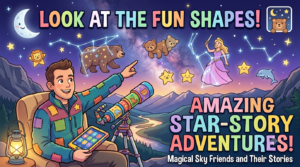
  • Shapes in Stars (Constellations)
  • Greek Stories
  • You are an Astronomer on your own

Lecture 02: Astronomy II
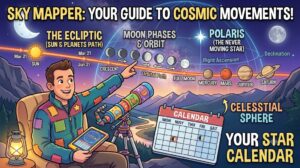
  • Patterns of Movements in Sky
  • Objects in Sky
  • Movement of Sun (The Ecliptic)
  • Movement of Moon
  • Phases of Moon
  • 5 other Planets
  • The Polaris (Never Moving Star)
  • The Celestial Sphere
  • The Calendar