- Understanding Python and how programs work
- Using print statements for output
- Introduction to variables and basic data types
- Taking input from users
- Writing simple interactive programs
About Program
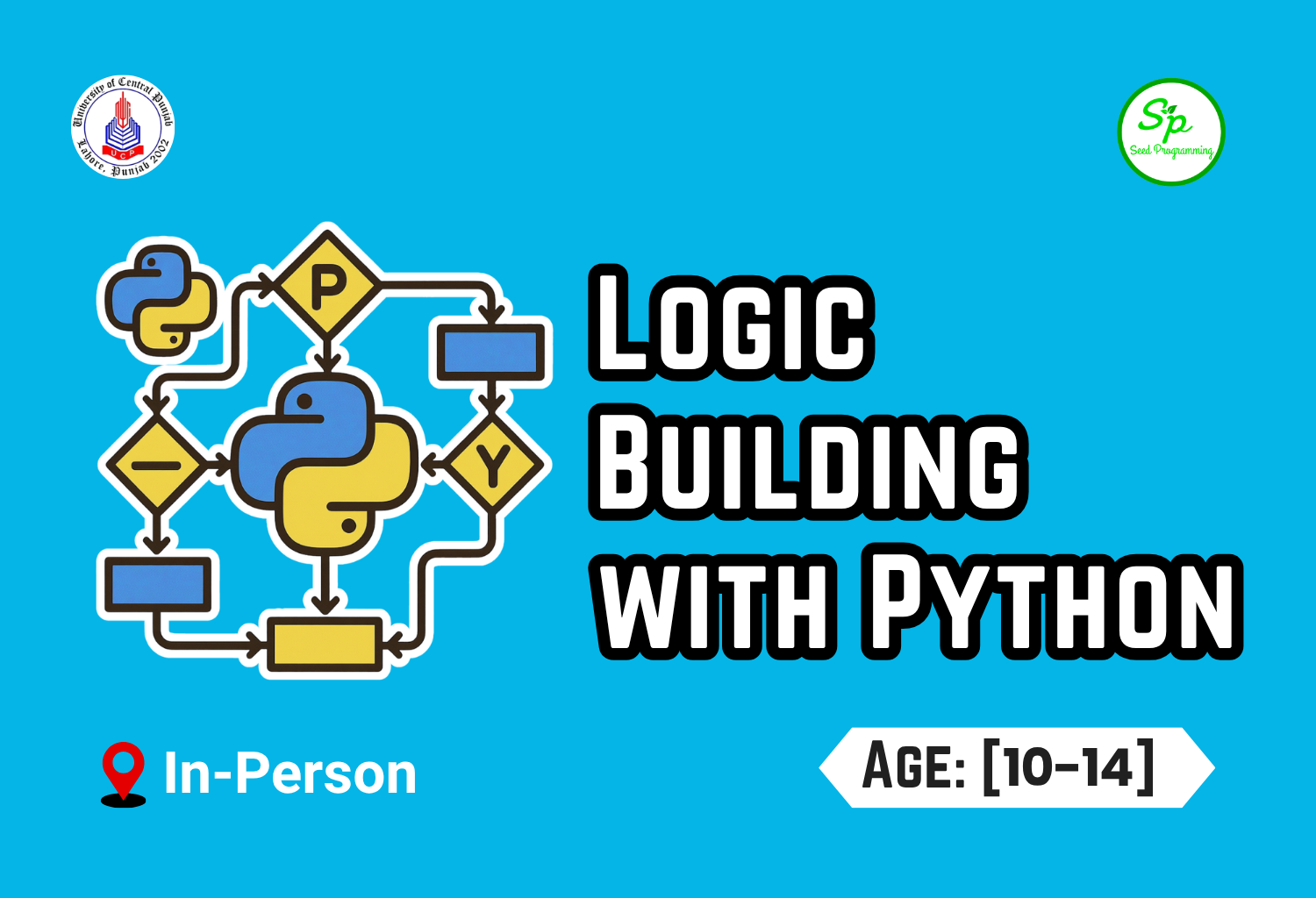
This course is designed to introduce students to the world of programming using Python. Students will learn fundamental concepts such as variables, loops, conditional statements, and modular programming, along with an introduction to the divide-and-conquer approach. By the end of the course, students will be able to build basic applications, solve programming problems, and develop a strong foundation for more advanced programming courses.
In Collaboration with University of Central Punjab (UCP)
Course Outline
Lecture 1: Introduction to Python & Basics
Lecture 2: Loops & Pattern Printing
- Introduction to while and for loops
- Understanding step-by-step execution
- Printing number sequences and tables
- Creating simple patterns using loops
- Debugging loop-based programs
Lecture 3: Conditional Statements
- Using if, else, and elif conditions
- Handling multiple conditions logically
- Building decision-based programs
- Combining conditions with operators
- Solving real-life logical problems
Lecture 4: Problem Solving with Loops
- Solving problems using loops and logic
- Introduction to nested loops
- Finding prime numbers and square roots
- Computing GCD and LCM
- Validating mathematical results using code
Lecture 5: Functions & Code Reusability
- Introduction to functions in Python
- Writing reusable and clean code
- Passing arguments and returning values
- Breaking problems into smaller parts
- Using divide and conquer approach
Lecture 6: Advanced Pattern & Shape Printing
- Creating complex patterns using loops
- Printing hollow shapes and designs
- Building diamond and star patterns
- Using nested loops creatively
- Improving logic through practice
Lecture 7: Introduction to Lists & Data Handling
- Understanding lists and data storage
- Finding max, min, and sorting values
- Removing duplicates from lists
- Searching and filtering data
- Basic list operations and methods
Lecture 8: Dictionaries Basics
- Introduction to dictionaries (key-value pairs)
- Accessing and modifying dictionary data
- Iterating using keys and values
- Comparing lists vs dictionaries
- Real-world data representation
Lecture 9: Advanced Dictionary Operations
- Inserting and deleting elements
- Merging and concatenating dictionaries
- Nested dictionaries (dictionary of dictionary)
- Working with structured data
- Practical problem solving
Lecture 10: Data Processing with Dictionaries
- Removing duplicates and finding uniques
- Counting frequency (words, values)
- Dictionary of lists
- Handling real datasets
- Optimizing data operations
Mini Project – Record Management
- Building a simple record management system
- Storing and retrieving data
- Applying conditions and loops together
- Improving code structure
- Testing and debugging
Final Project & Review
- Combining all Python concepts learned
- Building a complete mini project
- Code optimization and best practices Final Project:
- 🤖 Create your own AI assistant
- Understand how AI answers questions using knowledge
- Learn responsible and ethical use of AI
- Combine Python, visuals, and AI into one mini application
~ STEP BY STEP GUIDE TO INSTALL VISUAL STUDIO CODE
- Search for “Visual Studio Code” in Google Chrome and click the download option on the official website
- Choose the appropriate version for your computer, such as the Windows or MacBook option, to start the download
- Once the installer is open, select the “I accept the agreement” option and click next to proceed with the setup
- During setup, ensure you check the boxes for “Create a desktop icon” and, most importantly, “Add to path” before clicking install
- You can create a new Python script by adding a file with the .py extension, such as
myprogram.py - The environment also supports notebook files, which can be created by using the .ipynb extension
- Navigate to the Extensions view and search for and install the “Python Debugger” extension to enable full Python support and debugging capabilities
Lecture 01: Introducing Python with Print, Variables - While loop, conditionings, Debugging
- Introduction to programming and Python
- Using the print() function for output
- Printing text, numbers, and expressions
- Introduction to variables and storing values
- Using variables in calculations
- String operations using + and *
- Introduction to the while loop
- Generating number sequences with loops
- Printing patterns using loops
- Checking and understanding program output
Lecture 02: Shape Printing using While Loop
• Explain why functions are needed.
• Differentiate between built-in and user-defined functions.
• Define and call functions.
• Explain arguments and parameters.
• Trace function execution using the Visual Studio Code debugger.
• Explain modular programming.
• Use the for loop and range().
• Compare while and for loops.
• Use the break statement.
• Build a menu-driven program.
Lecture 03: Functions and For Loop (PART 1)
• Explain why functions are needed.
• Differentiate between built-in and user-defined functions.
• Define and call functions.
• Explain arguments and parameters.
• Trace function execution using the Visual Studio Code debugger.
• Explain modular programming.
• Use the for loop and range().
• Compare while and for loops.
• Use the break statement.
• Build a menu-driven program.
Lecture 03: Functions and For Loop (PART 2)
• Explain why functions are needed.
• Differentiate between built-in and user-defined functions.
• Define and call functions.
• Explain arguments and parameters.
• Trace function execution using the Visual Studio Code debugger.
• Explain modular programming.
• Use the for loop and range().
• Compare while and for loops.
• Use the break statement.
• Build a menu-driven program.
Lecture 04: Control Structures and Input Validation
- Finding the Maximum & Minimum Efficiently
- Transition from rigid if/elif checks to a single-pass loop algorithm for large datasets.
- Track both minimum and maximum values dynamically within the same loop.
- Mastering Logical Operators (and / or)
- Input Validation & Clean Control Flow
- Optimize conditional chains by removing redundant, overlapping range checks.
- Construct a menu-driven interface using loops and conditional logic for continuous user interaction.
Lecture 05: Real World Problem Solving
- Introduction to CodeChef
- Popcorn Movie Ticket Problem
- POINTCAL: Score-Type Question
- Jumping Frog Problem
- W3Schools Guide for Python
- Rock Paper Scissors: Hidden Input Method
- Input-Validation Edge Case
Lecture 06: Lists, Functions, and Searching
• Create and access lists using indexing.
• Traverse lists using loops.
• Use the len() function.
• Write reusable functions.
• Solve problems using lists.
• Understand universal and existential search patterns.
• Differentiate between print and return.
• Use the match-case statement.
• Solve a palindrome problem using lists.